
Carry-On Only With a Tailcoat: How a Travelling Conductor Packs for the World
It's Friday evening in a concert hall, somewhere in Europe. In twenty minutes, I'll make my debut here — standing in front of an orchestra I've never conducted before a live audience. The tailcoat fits. The score and the baton are ready. Everything I need — for this trip and every other — fits into my carry-on suitcase, a small backpack, and one slim, elegant bag.
No checked luggage. That means: no queue at check-in. No wondering whether the suitcase will make the connection in Frankfurt. No waiting at the baggage carousel. No risk that the tailcoat gets lost somewhere between Palermo and Helsinki while I need to be on stage tomorrow night.
When I tell people that I travel to concerts and opera performances with carry-on luggage only, I'm usually met with disbelief. In a tailcoat? In a tailcoat. And with concert shoes, a week's worth of clothing, everything I need to work. It took years to develop this system — and one single upgrade that changed everything.
The garment bag
For years, I carefully folded my tailcoat into suitcases of every size — following a system I'd developed over time through trial and error and internet hacks. One shoulder tucked into the inverted shoulder of the opposite side, then folded as flat and as few times as possible, the trousers, shirt and waistcoat layered in the middle, the whole thing wrapped in a towel. It worked — mostly. After the taxi or train from the airport, the first thing to do at the hotel was to unpack the tailcoat immediately: every minute counted, hanging it up to let the creases fall out before standing on stage twenty-four hours later. Sometimes they did fall out. Sometimes they didn't.
The problem wasn't the tailcoat itself — decent tailcoats of good quality are more resilient than you'd think. The problem was that everything else in the suitcase pressed against it: shoes, scores, the toiletry bag. No matter how skilfully it was packed, the tailcoat was never truly protected; it was simply along for the ride.
Now, when you buy a good suit, you usually get a garment bag with it — a simple fabric sleeve in which you can proudly carry your new acquisition home. As long as it stays hung up at full length, the tailcoat inside is stored completely crease-free. But fold it in half for transport, and the trouble begins: there are no sturdy handles, the hanger often slides down inside the bag, and the tailcoat collapses — and creases — from within. So I decided: a proper, structured garment bag was the answer. That solves many problems but creates new ones: these bags are standalone pieces of luggage the size of a small suitcase, easily accommodating shoes and underwear alongside the suit, and before long you're back to the same creasing problem, because everything is pressing against the tailcoat again.
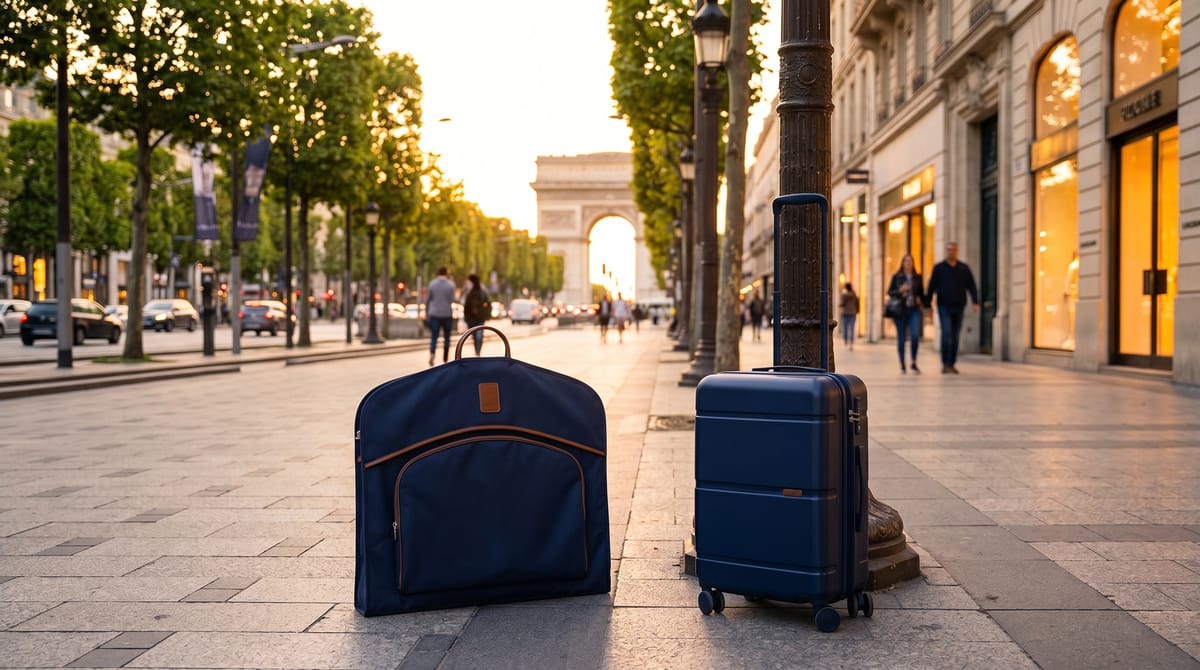
During an engagement in Paris, I wandered down the Avenue des Champs-Élysées one afternoon and came across the garment bag by Longchamp. Thin, light, rather unassuming — at first glance, not the kind of item you'd spend serious money on. But that's precisely the point: it separates the tailcoat physically from the rest of the luggage, it's remarkably firm and sturdy, and it offers exactly enough room for a single suit — or, in my case, a tailcoat. The front pocket fits the bow tie and braces. And because the bag is so slim, it works as an additional piece of hand luggage on every aircraft I've ever boarded — it simply lies flat on top of the carry-on in the overhead bin.
It sounds like a small thing — but it was the single biggest upgrade to my entire travel system. The garment bag is now both a functional necessity and a style statement, because it genuinely looks the part. Carrying it by its leather handle through the terminal makes you feel a quiet kind of pride. I now stand before the orchestra without having spent half an hour wrestling with a hotel iron. The tailcoat looks as though it came from the tailor, not out of a suitcase.
The packing system
The Longchamp garment bag solved the big problem of getting a tailcoat, a tuxedo, or a dark navy suit to its destination in style and without creases — but that only works because the rest of the system holds up. A tailcoat alone doesn't get you through a week of concerts. You still need everything else: everyday clothes, shoes, tech, scores. And all of it has to fit into a single carry-on suitcase.
My system has three parts. The garment bag for the tailcoat and its accessories. A carry-on suitcase for nearly everything else. And a small backpack as my personal item, home to what I need during the journey: MacBook Air, iPad, charging cables, passport, headphones, metronome, water bottle.
The suitcase follows one simple principle: everything that goes in must be combinable, and it must be light. I travel with a small wardrobe limited to a few colours. Three shirts, two pairs of trousers, a pullover or two T-shirts depending on the season. Everything works with everything. Add an elegant two-piece evening suit for the after-show reception — and of course the scores and the baton. I also always carry laundry sheets for emergencies — they work wonders even in a hotel sink.
Shoes are the hardest packing problem. Concert shoes are non-negotiable — no shoes, no performance — so they go into the suitcase. That leaves one pair of shoes that has to work for the journey, for rehearsals, and for exploring Madrid — or Munich, or Malmö. In my case, these are always Goodyear-welted leather shoes with a sturdy rubber sole — for years now from Loake, an English shoemaker with experience dating back to 1880. They look as good in rehearsal as they do on cobblestones, and with proper care they last years — more than justifying the higher price.
What doesn't go into the suitcase is at least as important as what does: I travel without "just in case" clothing. No extra pair of shoes, no umbrella. If I had something with me last week and didn't use it, it stays home the next time — unless there's a compelling reason to keep it.
I also never carry scores I'm studying for future weeks in paper form — but more on that another time.
Lessons from the road
This system did not appear overnight. It's the result of years of experimenting, failing, and slowly refining — in airports, in hotels, and sometimes in the dressing room or backstage.
In the early years of my career, I always packed too much. Two pairs of shoes on top of the concert shoes; foul-weather clothing I never wore; a toiletry bag with bottles for every conceivable scenario; an umbrella I used exactly once — in three months. I travelled with a large checked suitcase and lived in constant unease about whether it would arrive. Once, the checked bag was badly damaged — I stood at a Spanish airport with a wreck instead of a suitcase, struggling to get my belongings safely to the hotel. Another time, it didn't arrive at all. I was in Cologne, the dress rehearsal was the next day, and my tailcoat was stuck in the suitcase somewhere between two airports. Shortly after those incidents, I stopped checking luggage for good.
The most important lesson over the years has been that comfort doesn't come from the quantity of things you carry, but from the security and calm of knowing everything works. A perfectly packed carry-on gives me more peace of mind than a full suitcase that has me checking the AirTag on Apple's Find My every five minutes to see whether it even landed in the same city I did. I know where every item is. I know everything is there. And I'm in a train or taxi twenty minutes after landing, while others are still waiting for their bags.
The other lesson is less practical and more philosophical: you need astonishingly little. The fear of forgetting something or not having enough fades after the third or fourth carry-on trip. What remains is a feeling of lightness — literally and figuratively.
The carry-on philosophy
When someone asks me why I travel carry-on only, I usually expect a conversation about packing strategies and suitcase models. The honest answer, though, is a different one: because it makes me freer.
Free from airport logistics. Free from worrying about delayed, damaged, or lost luggage. Free to catch the last train from the airport into the city without waiting for a suitcase. Free to focus on what I'm actually travelling for: the music.
I regularly stand before orchestras I've never conducted, in cities I've never visited. That's exhilarating on the one hand, and exhausting on the other. The last thing I need is a travel system that creates uncertainty. My carry-on gives me the opposite: a quiet foundation that makes everything else possible.
Minimalism in travel doesn't mean deprivation. It means that every item earns its place — and that anything which doesn't earn its place stays home. The tailcoat in the Longchamp garment bag. The Loake shoes that work for rehearsal and for exploration. A suitcase I can pack in fifteen minutes. I don't need more — and I don't want more.
– The Travelling Conductor